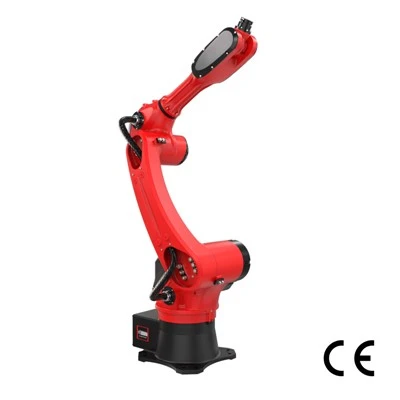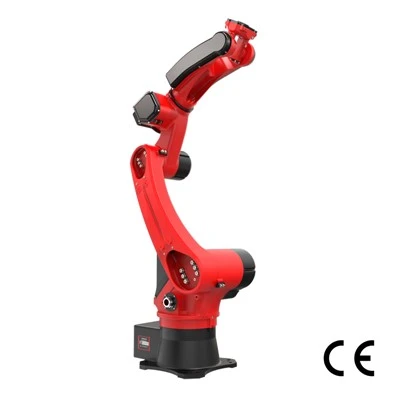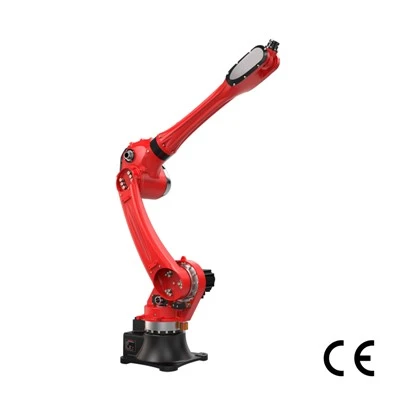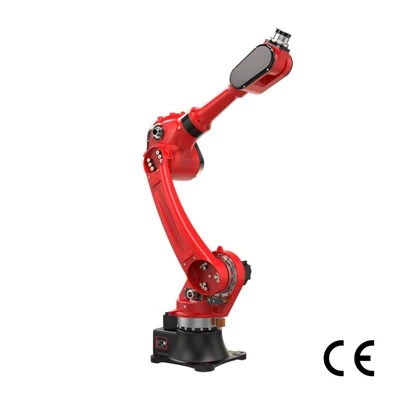


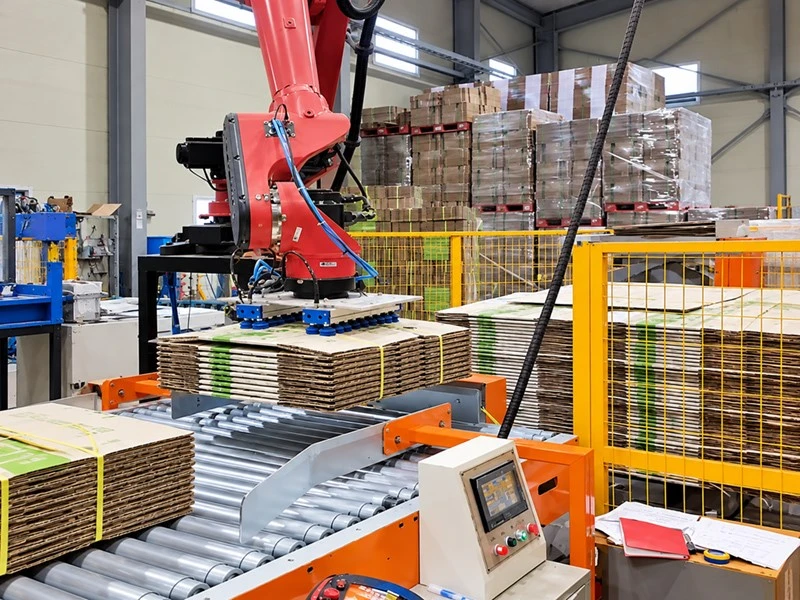
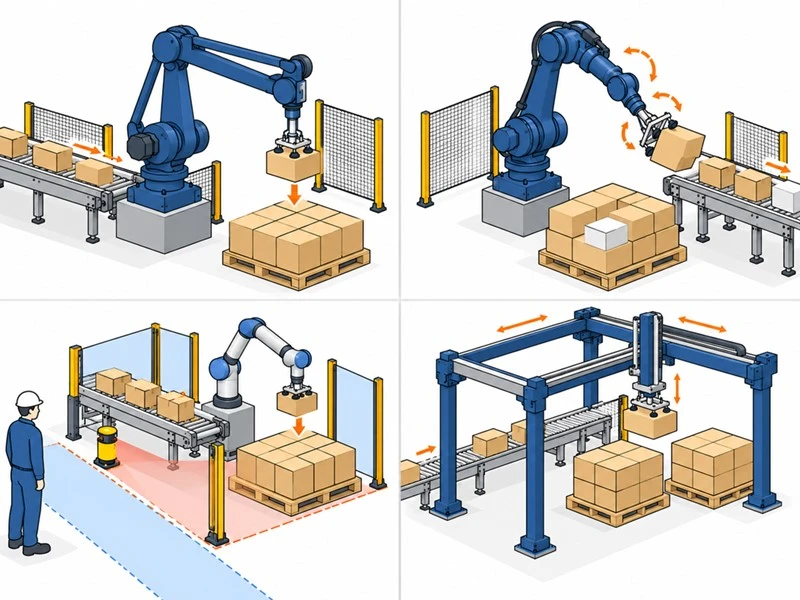
The main types of robotic palletizers are four-axis articulated robots, six-axis articulated robots, collaborative robots (cobots), and Cartesian or gantry robots. Each can automate stacking cartons, bags, or other packaged goods onto pallets, but each solves a different handling problem. The best choice depends on package orientation, payload, reach, production rate, floor layout, and operator access.
These categories are not mutually exclusive: a cobot may also be a six-axis articulated robot. Likewise, single-line or multi-line palletizing describes how a cell is arranged, not the mechanical structure of its robot. This guide explains the practical differences and provides a screening method for engineering and purchasing teams.
What Types of Robotic Palletizers Are Available?
Understanding robotic palletizing system types begins with three separate questions: How is the robot built? Can the application support collaborative operation? And how is the overall cell arranged? Industrial robots can be classified by their mechanical structure. The International Federation of Robotics' industrial robot classifications distinguish articulated arms with rotary joints from Cartesian robots with linear axes. Four-axis and six-axis palletizers are two articulated configurations; collaborative describes intended operating capabilities, rather than a separate mechanical geometry.
|
Palletizer design |
Main characteristics |
Common applications |
Key consideration |
|
Four-axis articulated |
Palletizing-oriented joint motion |
Repetitive cartons, cases, bags |
Product orientation |
|
Six-axis articulated |
Additional wrist and approach flexibility |
Mixed packages, complex gripping |
Motion planning |
|
Collaborative robot |
Collaborative-capable design, subject to risk assessment |
Flexible, moderate-demand lines |
Payload, reach, safe speed |
|
Cartesian / gantry |
Linear X-Y-Z movements |
Rectangular or multi-position workspaces |
Structure and clearance |
|
SCARA / Delta (specialized) |
Application-specific fast handling |
Lightweight or upstream pick-and-place |
Usually not full-height pallet stacking |
A robot's axes affect how it approaches and rotates a package, but do not by themselves establish throughput or usable payload. Review the actual arm, tool, pallet pattern, and installation geometry together. Explore RBTIC palletizing robots for available product configurations.
Four-Axis Articulated Robotic Palletizers
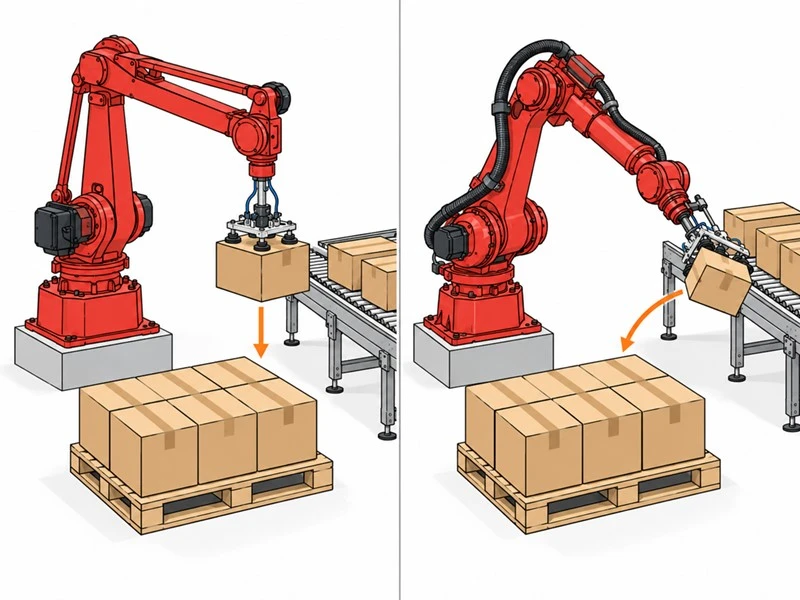
A four-axis robotic palletizer is typically engineered for repetitive transfers with a controlled tool orientation. It is well suited to sealed cases arriving at a consistent conveyor position and being stacked in established patterns, including many food-and-beverage cartons and building-material bags.
When are four axes enough? Start with three checks. Can the gripper approach every package from a suitable direction? Can the robot place every case without demanding an awkward wrist angle? And can it reach the far pallet corners and highest layers without striking the stack or surrounding equipment?
If the answers are yes, additional wrist freedom may offer little benefit. A four-axis design can be a practical high-speed palletizing robot candidate, but its actual output still depends on travel distance, EOAT, load, acceleration, and pallet changes.
For perspective, ABB's IRB 460 is a four-axis palletizing model with 110 kg payload and 2.4 m reach. At a much smaller scale, RBTIC's BRTIRPZ1508A industrial palletizing robot is listed with 8 kg loading ability and 1,413 mm arm length. These differences show why axis count alone cannot establish capacity or suitability.
Four axes may become restrictive when a carton must tilt, when the pickup face changes substantially, or when the gripper must approach through tight obstacles. Test the complete pallet pattern rather than assuming that a straightforward first-layer movement proves the design.
Six-Axis Articulated Robotic Palletizers
A six-axis robotic palletizer adds wrist movements that let its tool change orientation while traveling between the pickup point and pallet. This is useful for mixed products, irregular presentation, constrained access, and lines where one gripper serves more than one handling task.
When should you consider six axes? Look for requirements such as turning a package between pickup and placement, approaching a case from the side, or avoiding nearby conveyors and guarding. Six-axis motion can also make a future layout change easier to accommodate, provided the robot has enough reach and load capacity.
For example, RBTIC's BRTIRUS2550A palletizing robot arm has six axes, 50 kg rated payload, and 2,563 mm reach. Its published 50 kg rating includes the combined mass of the product and gripper. A 10 kg EOAT therefore leaves at most 40 kg for products before checking center of gravity, inertia, and other load restrictions.
A six-axis arm does not automatically run faster or cost less to integrate. Complex wrist paths can increase movement time, and greater freedom may require more careful programming. Compare realistic pick-to-place trajectories, not just catalog joint speeds.
For mixed-SKU consumer goods or manufacturing cartons, the key question is whether the required orientation changes are achievable with a simpler arm and tool. If not, six-axis flexibility may justify its additional engineering demands.
Collaborative Robotic Palletizers (Palletizing Cobots)
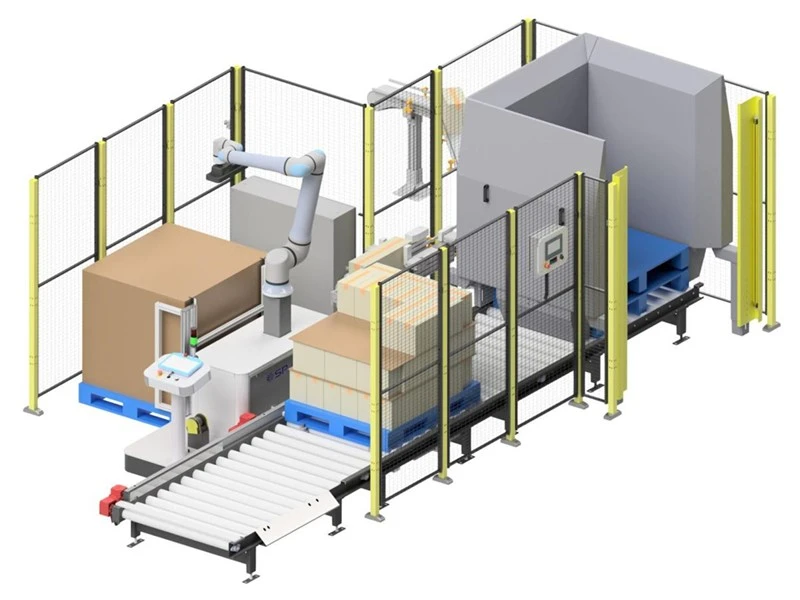
A collaborative robotic palletizing system for low-volume lines may suit facilities where employees regularly change recipes, replenish packaging, or work near the palletizing area. Cobots are often articulated arms; their defining feature is the availability of collaborative-related control and safety functions, not a guaranteed fence-free installation.
RBTIC's palletizing cobot is listed with a 30 kg payload, 1,900 mm working radius, and an integrated lifting mechanism supporting a stated 2,600 mm maximum palletizing height. These published values must be checked against the actual package, gripping arrangement, and usable workspace.
A cobot is not automatically safe without fencing. A loaded gripper can create crushing points; pallets, conveyors, and unstable cartons introduce additional hazards. Universal Robots' risk-assessment guidance requires an application-specific assessment that may call for guarding, scanners, speed restrictions, or other protective measures.
This matters commercially as well as technically. If safety-related speed reductions prevent the cell from meeting peak demand, a guarded industrial robot may be a better choice even in a relatively small factory. Compare installed footprint and validated output, not the cobot's size alone.
Cartesian and Gantry Robotic Palletizers
A Cartesian palletizing robot moves along linear X, Y, and Z axes. In an overhead gantry robotic palletizing system, the moving mechanism is mounted on a supporting frame, giving it access to a defined rectangular work area and potentially several fixed pallet positions.
Consider a gantry when the site needs systematic coverage over widely spaced stations or when an overhead mechanism fits an existing process. Linear movement can make position planning straightforward, especially with uniform packages and repetitive destinations.
However, the frame itself is part of the footprint. Check column positions, overhead beams, ceiling clearance, forklift routes, access doors, maintenance space, and the gripper's ability to rotate packages. A gantry is an alternative system architecture discussed here.
SCARA and Delta robots also appear in industrial handling, but they usually serve lighter upstream pick-and-place tasks rather than full-height shipping-pallet stacking. For most end-of-line projects, compare the four primary options above first.
How Does a Robotic Palletizing System Work?
How does a robotic palletizing system work in a packaging plant? The robotic palletizing process coordinates product detection, gripping, programmed placement, and pallet discharge. It is a coordinated workcell, not simply a robot arm. The conveyor, sensors, end-of-arm tooling (EOAT), robot controller, programmable logic controller (PLC), and safety equipment must act in sequence to create stable pallet loads.
Step-by-Step Robotic Palletizing Process:
1. Infeed: A conveyor presents a sealed carton, bag, or other package at a defined pickup position.
2. Detection: Sensors confirm arrival and position; a vision system may identify variable products or orientations.
3. Pick: The robot grips the product using vacuum cups, clamps, forks, or application-specific tooling.
4. Place: A stored recipe positions the load according to the palletizing pattern, including specified orientation and layer offsets.
5. Layer completion: Repeated transfers build the stack; optional equipment can insert slip sheets.
6. Pallet exchange: A full pallet leaves and an empty pallet enters, manually or automatically.
7. Feedback: PLC and HMI signals coordinate ready states, interlocks, alarms, and upstream/downstream handshakes.
The EOAT needs enough holding force without crushing packages or losing grip when acceleration changes. Sensors need to detect misfeeds and absent pallets rather than letting the robot continue into an unsafe or incorrect sequence.
Safety functions are equally integral. Guards, presence sensing, interlocks, and safe-motion settings must be selected through a risk assessment for the installed cell, including pallet removal and maintenance activities. Before acceptance, test the complete line with real packages and expected fault conditions.
Common Robotic Palletizing Cell Configurations
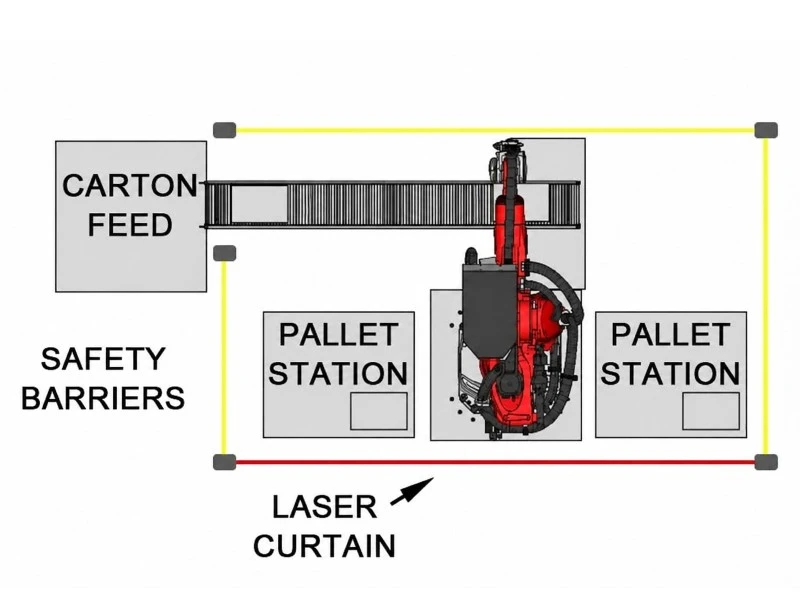
Cell configuration describes product flow and pallet-station arrangement; it does not identify a different robot type. A four-axis or six-axis arm may be used in several of these layouts.
- Single-line palletizing: One conveyor feeds one pallet position. It simplifies sequencing but can interrupt production during pallet exchange unless buffering or another arrangement is provided.
- Dual-pallet positions: One robot serves two pallet stations, allowing an operator or transfer mechanism to replace one pallet while the other is being filled. Confirm reach, switching logic, and protected access to each station.
- Multi-line palletizing: Several conveyors share robotic capacity. This reduces duplication of equipment where demand permits, but the combined peak arrival rate and queueing can turn the shared robot into a bottleneck.
- Full-layer handling: Equipment forms a layer before the robot transfers it as one unit. This reduces the number of transfers per layer, but requires sufficient payload, a stable formed layer, and specialized tooling.
As a heavy-duty reference, ABB's IRB 760 is a four-axis robot rated for 450 kg and intended for tasks that include full-layer palletizing. It demonstrates why handling architecture and layer weight matter as much as the number of axes.
A packaged or relocatable cell can simplify some deployment work, yet it still needs verified utilities, anchoring, interfaces, and safeguarding. RBTIC describes integration support for tooling, conveyors, PLCs, vision, safety systems, and commissioning.
How to Choose the Right Robotic Palletizing System
The best robotic palletizing system is the one that can meet the complete application's requirements at an acceptable installed cost. Begin by eliminating candidates that cannot safely grip the product, reach every position, or sustain the required output.
Key Selection Factors
Collect these seven groups of information before selecting a model:
1. Product characteristics: Minimum and maximum dimensions, mass, packaging rigidity, surface condition, leakage risk, and acceptable damage limits. Flexible bags may require a different gripper from corrugated cases.
2. Production demand: Average and peak cases per minute, shift schedule, planned operating availability, and upstream accumulation. Peak rates determine whether buffers or multiple cells are necessary.
3. Payload and EOAT: Add the heaviest product, tool, brackets, and other moving attachments. Check the resulting center of gravity, inertia, wrist moment, and dynamic limits.
4. Reach and stack geometry: Include conveyor pickup location, pallet edges, top-layer height, gripper overhang, and approach clearance. A published reach figure is not a guarantee that every pose is attainable.
5. SKU and pattern flexibility: Record current and planned products, required rotations, recipe changes, and gripper adjustments. Frequent format changes favor adaptable tooling and controls.
6. Layout and operator safety: Map guarding, pallet removal, pedestrian and forklift paths, ceiling height, utilities, and maintenance access. The protected cell footprint can exceed the arm's footprint.
7. Total ownership requirements: Compare robot, EOAT, conveyors, guarding, integration, training, spares, maintenance, and future expansion under equivalent assumptions.
Matching Robot Types to Production Requirements
Use real constraints to narrow the options rather than naming one robot type for an entire industry.
|
Known production condition |
Selection implication |
Confirm before specifying |
|
Cases must rotate or change gripping face |
Evaluate six-axis orientation control |
Rotation angles, pickup faces, interference |
|
Packages or full layers are heavy |
Screen high-payload arms and layer tooling |
Product + EOAT mass, moments, inertia |
|
Several lines share one cell |
Assess scheduling, buffering, and shared capacity |
Each line's peak rate and pallet-change time |
|
SKUs change frequently |
Prioritize recipes and adaptable EOAT |
Size ranges, changeover time, gripping reliability |
|
Floor space is restricted |
Compare installed layouts, not arm bases |
Reach envelope, guarded aisles, maintenance |
|
Pallets are tall or far from pickup |
Test upper and far-corner positions |
Maximum height, tool clearance, joint limits |
A practical screening sequence is to start with the load and stack geometry, then test the required orientations. If the motion is simple, evaluate four-axis options first. If substantial reorientation or obstacle avoidance is essential, add six-axis candidates. Consider collaborative operation only after the risk assessment and safe cycle-time requirements are defined; consider a gantry where the site's fixed geometry supports it.
For example, a case-packing line with uniform cartons, a fixed pickup orientation, and one pallet position might justify a four-axis shortlist. If its next product requires side gripping and rotation around adjacent equipment, that same shortlist should be reopened. This is an illustrative decision scenario, not a claimed customer installation or measured performance result.
Throughput and Payload Verification
For an initial robotic palletizing throughput calculation, suppose the packaging line produces 12 cases per minute. That is 720 cases per hour. At 90% effective cell availability, the cell must average 800 successfully placed cases per operating hour to maintain the planned hourly output:
12 × 60 ÷ 0.90 = 800 cases per operating hour
That becomes 800 placements per operating hour only when one case is placed per robot transfer. Multi-pick grippers change the number of transfers. Full-layer handling changes it further, while pallet exchange, product spacing, rejected grips, and protective stops all affect effective output.
Translate the target into a complete cycle model: product presentation, gripping, motion, release, return travel, and all interruptions. A theoretical average of 4.5 seconds per placement at 800 placements/hour is only a starting point; actual cycles vary with layer position and load. Verify sustained performance during representative production, not a single favorable test.
For payload, a 35 kg case plus 12 kg EOAT equals 47 kg before other attachments. A 50 kg-rated arm may appear sufficient by mass, but the application still needs checks for tool center of gravity, inertia, allowable moments, acceleration, and installation orientation. Request the manufacturer's load diagrams and a motion simulation.
Finally, specify factory and site acceptance tests. Measure good cases per minute, completed pallet quality, changeover time, recovery from faults, interfaces, and the verified operation of protective measures. Do not treat a catalog payload or cycle claim as a finished system guarantee.
Robotic Palletizer vs. Conventional Palletizer
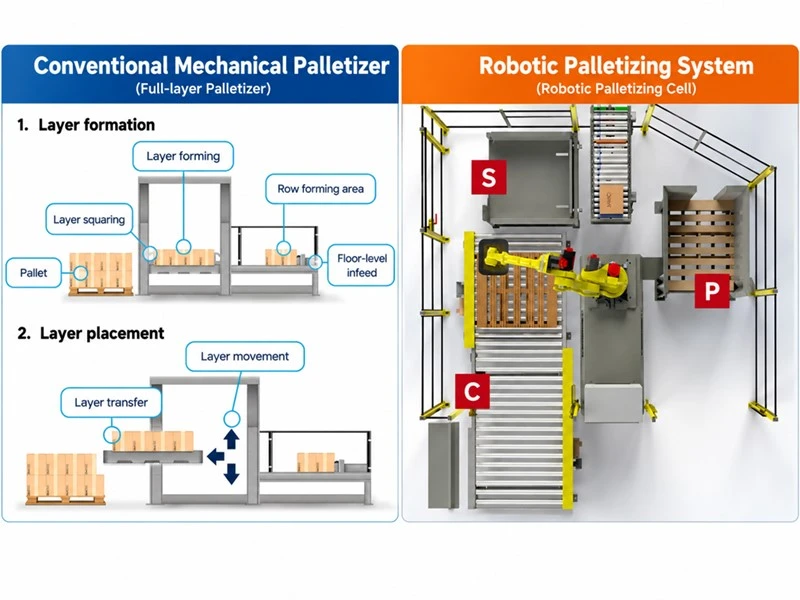
A robotic palletizer uses programmable motion and EOAT to place individual packages or complete layers. A conventional palletizer generally uses coordinated mechanical operations to accumulate, form, and transfer layers. Both can be appropriate for an end-of-line packaging system.
|
Decision factor |
Robotic solution |
Conventional solution |
|
Product variety |
Recipes and suitable EOAT support changing formats |
Often strongest with well-defined formats; changeover depends on design |
|
Throughput |
Depends on robot paths, picks per cycle, and cell layout |
Layer-forming systems can suit sustained, uniform high-volume flow |
|
Space |
Arm may be compact, but guarding and pallet access need space |
Infeed, accumulation, and layer-transfer equipment need space |
|
Integration |
Robot, EOAT, controls, conveyors, and safety |
Mechanical modules, controls, conveyors, and safety |
A conventional machine may be compelling when cartons remain uniform and high-volume layers are continuously formed. Robotic equipment may be more attractive when product variety or handling flexibility is a major requirement.
Neither is inherently faster, safer, or cheaper. Compare both using the same package samples, production duty, changeover frequency, floor plan, pallet specification, staffing assumptions, and expected maintenance costs. The comparison should evaluate total installed performance, not only the main machine.
Frequently Asked Questions
Get a Robotic Palletizing Solution for Your Line
The right selection starts with your production data-not a generic robot recommendation. RBTIC offers palletizing robot options and automation integration services covering tooling, controls, safety, and commissioning.
Before contacting us, prepare product dimensions and weights, packaging samples, target cases/minute, pallet size and stack height, production hours, floor plan, existing equipment interfaces, and the required delivery location. These inputs help identify custom robotic palletizing solutions that are sized for the real operating conditions.
Request a customized palletizing quote or speak with RBTIC about your technical requirements to discuss a configuration that can be verified against your line.