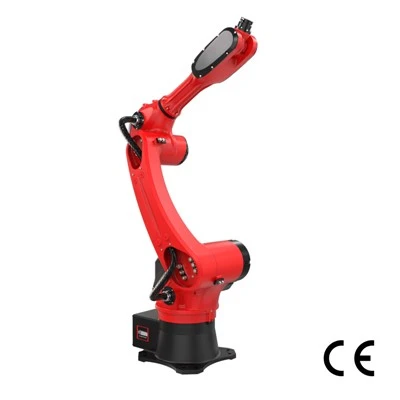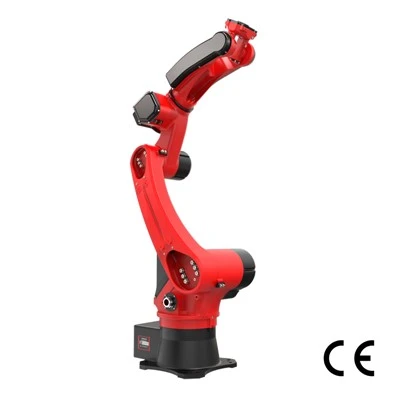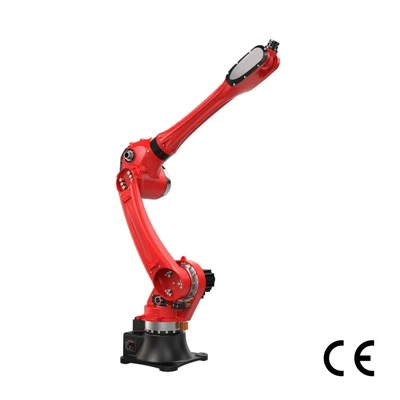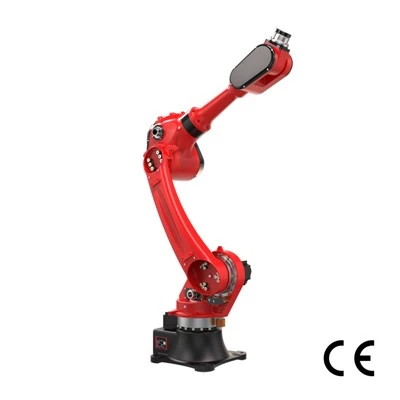


A Complete Robot Cell
A complete robotic cell consists of the robot arm plus custom fixtures and a full range of automated equipment tailored to specific application scenarios.
End Effectors & Custom Grippers

Here's the part that quietly decides projects: the end effector. The arm moves the gripper into position; the gripper does the actual work, making it the most underestimated component in the cell.Tool selection depends on the workpiece: pneumatic or electric grippers for general material handling, vacuum grippers for flat workpieces, magnetic grippers for ferrous metal parts, and a quick-change tool changer for multi-task switching on a single robot arm.
Because real parts vary so much, the norm isn't a special robot-it's a standard arm plus a custom gripper built for your part. This is where projects go wrong: if you spec the perfect arm but bolt on the wrong gripper, cycle time and yield collapse. Choosing the arm is the easy half; the gripper is where the risk lives.
Vision, Sensors and Part Presentation
Vision is exciting, so let us talk you out of it first. You genuinely need a machine vision robot when parts arrive unpredictably-random positions in a bin, mixed products, orientation you can't guarantee. But if the incoming parts can be located by a tray, nest, or robot fixture, a good fixture is almost always cheaper and more reliable than a camera. Vision adds real cost: the hardware, the tuning, and an ongoing lighting-and-maintenance burden-change a bulb or let sunlight shift and calibration drifts.
So the honest question isn't "should we add vision," it's "can we fix the part presentation instead?" Solve presentation with a fixture where you can; reach for vision only when the parts truly won't hold still.
Peripherals
A robot arm is just one line on your bill of materials. It is the robot peripherals that transform it into a fully functional welding cell.
Positioner
The positioner tilts or rotates the workpiece, enabling the robot arm to access surfaces that would otherwise be unreachable.
7th axis track
The 7th axis track is a rail system carrying the entire robot, extending its working reach over long distances or across multiple work stations.
Conveyor
The conveyor transports incoming raw parts and outgoing finished workpieces, establishing the operating rhythm of the robot cell.
Feeder / hopper
The feeder or hopper supplies raw workpieces with consistent positioning, allowing the robot arm to reliably locate and pick parts.
Control cabinet
The control cabinet accommodates the controller, servo drives and I/O modules that operate the entire robot cell.
Air supply
The air supply provides compressed air for pneumatic grippers and clamping fixtures. It is frequently underestimated until insufficient pressure disrupts production.
Safety & Compliance
Robot safety isn't one solution-it's matching the guard to the interaction. A physical fence suits a fully automated zone that operators do not enter during operation. A light curtain fits where operators come and go: cross the beam and the cell stops. Force-limiting suits a genuinely shared workspace. The deciding factor is straightforward: how often, and how closely, do people need to enter the zone? Whatever you pick, a risk assessment is mandatory anywhere a person can reach the working zone, and any time you run a new process.
A cobot doesn't exempt you-collaborative hardware still needs one. This is part of the integrator's job, not an afterthought bolted on at the end.
For the applicable standards, see ISO 10218-1/2 and ISO/TS 15066 →
Integration & Signals
A robot rarely works alone-it has to talk to the machines around it, and that conversation is robot integration. The core of it is the PLC handshake: your robot and your press, CNC, molding machine, or line controller trade signals-"I'm clear," "you're safe to close," "part is ready"-so they act in the right order instead of colliding. To enable seamless cross-device communication, all equipment communicates over common industrial protocols such as EtherNet/IP or Profinet.
The point worth internalizing: integration isn't installing a robot, it's getting a roomful of equipment to cooperate on cue. That coordination-not the arm itself-is the hard part, and it's the real reason a project needs someone who does integration, not just someone who sells robots.
What a Typical Deployment Looks Like
The 6 Steps
A typical robot deployment process runs in six steps, each with a deliverable.
Requirement
Define the part, cycle, layout, and success criteria.
Simulation
Model the cell to prove reach, cycle time, and no collisions before it's built.
Build
Assemble the arm, gripper, peripherals, and controls.
FAT (Factory Acceptance Test)
Run and sign off the cell on your parts at the builder's site, before it ships.
Install
Set it up on your floor and connect utilities and signals.
SAT (Site Acceptance Test) & Training
Re-verify performance in place, then train your team.
What to Prepare Before the Robot Arrives
A smooth install depends on what's ready before the truck arrives. The core robot installation requirements on your side: a prepared location with a floor or foundation that can take the loads and vibration; power and compressed air run to the cell at the right rating; and-easy to overlook-consistent incoming parts, since a cell tuned on clean, repeatable stock will stumble on stock that varies.
Maintenance and Service Life
Robot maintenance is light but not optional. Keep to the scheduled service intervals: re-lubricate the reduction gears, and inspect cables and hoses, which flex constantly and wear first. Periodically re-check repeatability so drift is caught before it shows up in your parts. Treated this way, a quality industrial arm has a long service life-many years of production-with the reducers and dress-out, not the arm itself, being what you replace along the way.
Three Very Different Jobs

Laser Welding, Stainless Steel Cover Plates
Thin stainless steel cover plates demand smooth, uninterrupted welds along contoured edge seams. The welding torch must sustain an exact fixed angle against the joint for the full welding cycle.
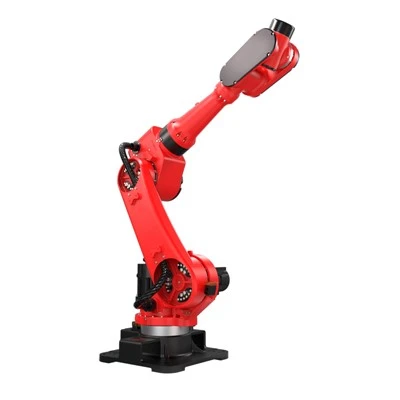
Basic positioning functions cannot trace curved contours while locking a steady torch angle. A slim-wrist six-axis robotic arm was therefore mandatory, not just an optional extra.
Robot Cell Layout
A synchronized servo positioner turns workpieces into accessible welding positions. Internal cable routing neatly tucks all wiring away from the weld travel path to eliminate interference.
Final Result
The cell delivers consistent, uniform laser welds across full-length weld seams. All performance metrics are signed off during FAT with customer-provided parts before shipment.
Press Tending with ±0.05 mm Placement Accuracy
This automated press-tending line required consistent part placement into the die within a ±0.05 mm tolerance for every cycle. The robotic arm must enter and fully exit the press in perfect synchronization with the ram stroke.
Repeatability was the core decisive specification here - working radius and travel speed were secondary factors. This arm was selected as it returns to each programmed taught position within ±0.05 mm on every single stroke.
Robot Cell Configuration
Pneumatic gripper tooling delivers rapid part handling. Meanwhile, safety zone interlock timing is fully synchronized with the press, ensuring the arm clears the die completely before mold closure.
Final Outcome
The arm maintains ±0.05 mm placement accuracy at the specified takt time, with zero unplanned press stoppages attributed to robotic malfunctions.


Palletizing of Curved Rigid Panels
Rigid curved panels required stacking into a stable pallet layout, yet their irregular geometry meant standard off-the-shelf grippers could not grip the parts reliably.
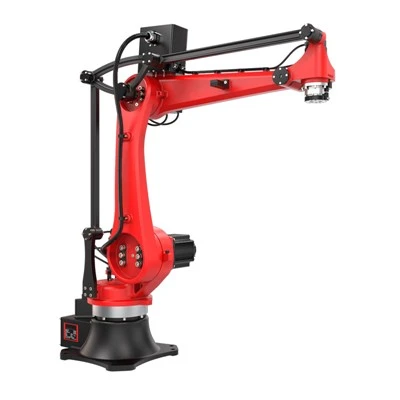
Unlike the previous two applications, choosing the arm itself was a straightforward decision: a 4-axis palletizer handled all lifting, rotating and placement movements. The decisive engineering factor was the end-of-arm tooling, not the robot - this component alone makes or breaks every palletizing task.
Robot Cell Configuration
We deployed a custom-machined gripper contoured to match the curve of the panels, paired with dedicated pallet pattern programming to guarantee stable stacking.
Final Outcome
The cell delivers steady, uniform palletizing of curved panels with zero dropped workpieces, freeing manual operators to attend to other production workflows.
The Bottom Line
A complete robot cell is a system, not a purchase. The arm positions; the gripper, the part presentation, the safety strategy, and the integration are what actually make the job run-delivered through a disciplined path from requirement and simulation to FAT, install, SAT, and steady maintenance. That's the pattern across all three builds above: the arm was rarely the hard part-the pose, the precision, or the gripper was. Tell us your part, cycle, and layout, and we'll spec the whole cell-arm, gripper, and integration-not just a robot.

FAQ
How long does it take to deploy a robot cell?
+
-
It follows the six steps-requirement, simulation, build, FAT, install, SAT-typically weeks to a few months. Custom tooling, simulation complexity, and FAT rework add time. A site with power, air, foundation, and consistent parts ready installs far faster.
How do I choose a robot integrator?
Pick someone who makes your equipment cooperate, not just sells an arm. Ask: Do you simulate before building? Handle the PLC handshake and signals? Produce the risk assessment? Sign off at FAT on our parts? A seller answers about the robot; an integrator, about your process.
Can one robot arm handle multiple jobs?
+
-
Yes-with a quick-change tool coupler, one standard arm swaps grippers and moves between jobs. The limit is rarely the arm; it's whether each job's gripper, part presentation, and cycle fit the same cell. Usually the real question is which gripper each job needs.