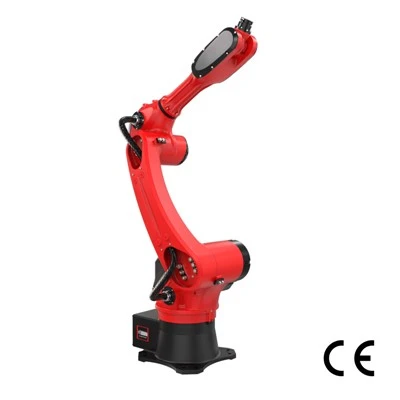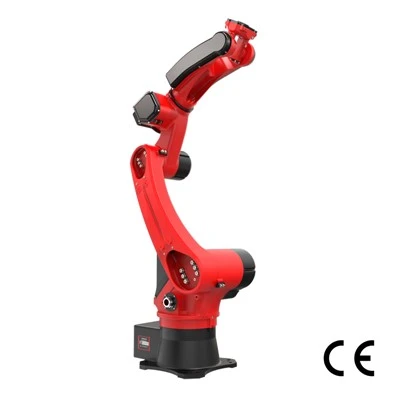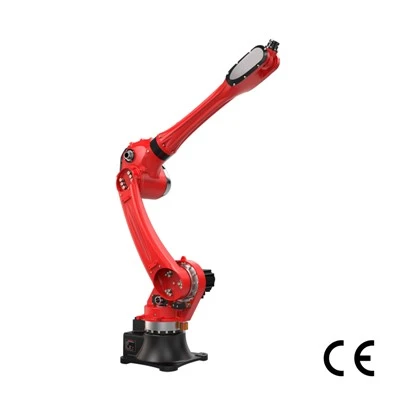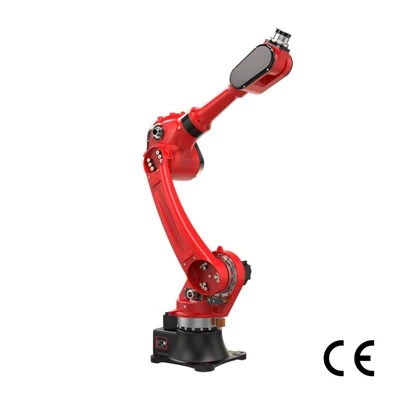


Buyers searching for palletizing robot pricing usually want a number they can use for budgeting. The difficulty is that a robot arm is only one part of a production-ready palletizing project.
Without an application specification, a single price range has limited decision value. A simple single-SKU case-palletizing cell and a high-throughput mixed-SKU system with automated pallet handling may both be described as "robotic palletizing systems," while having very different scopes.
A more useful way to evaluate cost is to understand the installed system cost structure and make sure competing quotations include comparable functions.
The key distinction is:
Equipment price ≠ installed project cost
The installed cost includes not only the robot and tooling, but also the equipment and engineering required to turn those components into a working production system.
If you are planning palletizing automation, explore RBTIC palletizing robot series to review configurations and specifications.
What Makes Up the Palletizing Project Cost?
A palletizing project can be viewed as a cost stack. Not every application needs every element, but a quotation should make clear which functions are included and which remain the buyer's responsibility.

A typical cost structure includes:
| System Component | Description |
|---|---|
| Robot | The robot, controller, base or pedestal, and associated robot hardware form the motion platform of the cell. Robot selection is influenced by payload, reach, speed, and the required operating envelope. |
| EOAT | The end‑of‑arm tooling physically handles the product. Costs can vary significantly between a relatively simple vacuum tool and specialized tooling for bags, drums, multiple products per pick, or a wide SKU range. |
| Conveyors and product presentation | Infeed equipment may be required to control product spacing, orientation, accumulation, and delivery to the robot. Finished‑load conveyors may also be required where pallets move automatically to downstream operations. |
| Safety system | A complete cell requires an appropriate safety architecture. The quotation may include guarding, controlled access, safety devices, safety controls, and integration-or some of those items may be outside the supplier's scope. |
| Vision and sensing | Vision may be required when the robot must locate products, determine orientation, identify SKUs, or read information such as barcodes. Additional sensors may also be required for product detection, pallet detection, grip confirmation, or process monitoring. |
| Pallet handling | Depending on the desired automation level, the project may include pallet dispensers, pallet conveyors, slip‑sheet handling, completed‑pallet transfer, or interfaces with downstream equipment. |
| Controls and software integration | The robot must communicate with conveyors, sensors, safety systems, upstream production equipment, and potentially downstream packaging equipment. Recipe management, pallet‑pattern software, line controls, and data interfaces all contribute to the integration scope. |
| Engineering and integration | Mechanical design, electrical engineering, programming, simulation, fabrication, assembly, testing, and project management can represent a substantial portion of the installed system cost. |
| Installation and commissioning | Shipping equipment to the plant is not the same as putting it into production. Installation can include mechanical assembly, electrical connection, field wiring, programming adjustments, startup, testing, and production validation. |
| Training and documentation | Operator training, maintenance training, manuals, electrical drawings, software backups, spare‑parts documentation, and other handover requirements may be included in the project scope or priced separately. |
A useful conceptual cost stack is:
Robot + EOAT + Conveyors + Safety + Vision + Pallet Handling + Controls/Integration + Installation + Training = Installed Palletizing Project
This is why quotation comparison should be based on scope, not simply the headline price.
A lower-priced proposal may exclude pallet conveying, field installation, pattern programming, safety equipment, or commissioning. Another supplier may include those functions in a turnkey price.
Before concluding that one solution costs less, determine whether both quotations end at the same system boundary.
What Drives the Palletizing Robot System Price Higher?
Knowing where money is spent is different from understanding why one application requires more expensive equipment or engineering than another.
Several application characteristics commonly increase system complexity.
Higher throughput
As required production rate increases, the system may need faster robot motion, shorter travel paths, more sophisticated product presentation, multi-pick tooling, additional accumulation, or parallel handling strategies.
For example, increasing throughput cannot always be solved simply by selecting a faster robot. The infeed, EOAT, pallet pattern, and pallet-change process must all support the required cycle time.
Higher payload
Increasing the weight handled per pick can affect both robot and tooling requirements.
A heavier payload may require a robot with greater load capacity, while the EOAT must also safely support and control the product. If multi-pick is introduced to increase throughput, the total pick load can increase rapidly even though individual product weight remains unchanged.
Multiple SKUs
SKU variability can increase cost through tooling, software, controls, and changeover requirements.
If one EOAT cannot handle the full product range, the system may require tool changes or more complex tooling. If pallet patterns vary by SKU, additional recipe and pattern-management functions may also be required.
The important cost driver is not the number of SKU names in a database. It is the amount of physical and control-system variation those SKUs introduce.
Machine vision
Vision adds more than the cost of a camera.
The system may also require lighting, mounting, calibration, processing hardware, communication with the robot or PLC, programming, testing, and exception handling.
This is why vision should be added to solve a defined positioning or identification problem rather than included automatically.
More complex pallet handling
Automated empty-pallet dispensing, slip-sheet insertion, full-pallet conveying, stretch-wrapper interfaces, and multiple pallet positions all increase the cell's functional scope.
They can also reduce manual intervention, so the additional capital cost should be evaluated against the operating benefit rather than viewed in isolation.
Difficult products
Deformable bags, fragile packages, unusual containers, unstable products, or inconsistent packaging may require specialized tooling, additional product-conditioning equipment, slower or more controlled motion, and more extensive testing.
Environmental or process requirements
The operating environment can introduce additional engineering requirements.
Washdown conditions, dust, temperature, cleanliness requirements, product hazards, restricted materials, or other site-specific constraints may affect component selection, enclosure design, electrical design, tooling, and installation.
These factors increase cost because they change the engineering problem-not simply because more components are being added.
Why the Cheapest Palletizing Robot May Not Mean the Lowest-Cost System
The lowest robot price and the lowest total palletizing cost are not necessarily the same thing.
This does not mean a buyer should automatically select the more expensive system. It means the comparison should extend beyond the initial purchase price.
A useful evaluation considers several dimensions together.
| Evaluation Factor | Description |
|---|---|
| Installed cost | What does it actually cost to get the system running in production?Confirm whether the price includes tooling, controls, safety, conveyors, installation, commissioning, training, and other required functions. |
| Uptime | A lower‑capital‑cost system can become expensive if frequent faults, difficult recovery, or unreliable product handling reduce production availability.The relevant question is not whether failures are theoretically possible, but how the proposed design deals with normal production variation and expected fault conditions. |
| Maintenance | Consider routine maintenance requirements, EOAT wear items, access for service, diagnostic capability, and the skills required to maintain the system.A highly specialized solution may be justified, but its maintenance requirements should be understood before purchase. |
| Changeover burden | For multi‑SKU production, determine what happens every time the product changes.Manual tool changes, mechanical adjustments, recipe entry, pattern changes, and operator verification all consume production time. Two systems with similar purchase prices may have very different long‑term operating burdens. |
| Spare parts | Identify critical spare components and their expected availability.The issue is not simply spare‑parts price. Lead time and availability can matter significantly when a single component can stop production. |
| Technical support | Understand who supports the system after commissioning.Robot manufacturer support, local integrator capability, remote diagnostics, response processes, and ownership of application software can all affect recovery when problems occur. |
| Expected service life and adaptability | A palletizing cell may remain in production while products, case sizes, pallet patterns, and line requirements change.An application that is highly optimized for one current SKU may be economical if the production requirement is stable. A more adaptable design may have greater value where future product changes are likely.Neither approach is automatically better. The objective is to match the system architecture to the expected operating life of the application. |
For purchasing decisions, total cost of ownership can therefore be viewed more broadly as:
Initial installed cost + operating burden + maintenance + downtime exposure + changeover cost + future modification requirements
This framework helps avoid two opposite mistakes: choosing a higher-priced solution simply because it appears more sophisticated, or choosing the lowest quotation without recognizing differences in scope and lifecycle cost.
A well-structured quotation should make it possible to understand what is included, what assumptions the supplier made, and what work or risk remains outside the quoted scope.
Final Thoughts: Budget for the Palletizing System, Not Just the Robot
The cost of a palletizing robot system depends on much more than the robot itself. EOAT, conveyors, safety equipment, pallet handling, controls, engineering, installation, commissioning, and training can all affect the final installed project cost.
The most useful comparison is therefore not simply which supplier offers the lowest headline price. Buyers should first confirm that competing quotations cover the same project scope, production requirements, and responsibility boundaries. Application details also matter. Throughput, product weight, SKU variation, pallet patterns, vision requirements, automation level, site conditions, and future changeover needs can significantly change the system architecture and engineering effort. A lower-cost configuration may be appropriate for a stable, straightforward application. A more flexible system may make better economic sense when production requirements are more demanding or likely to change. The right choice depends on the operating value the system is expected to create over its service life.
Before requesting a firm quotation, prepare the key application information: product dimensions and weight, target throughput, SKU range, pallet specifications, pallet patterns, available floor space, current labor requirements, upstream and downstream interfaces, and the level of automation required.
With those details, a system integrator can define the project scope more accurately and provide a cost estimate that is meaningful for both budgeting and ROI evaluation.
Ready to implement robotic palletizing?
Whether you are upgrading your end‑of‑line automation or searching for a reliable palletizing robot supplier, contact RBTIC for free custom palletizing solutions and layout designs, or to book a factory tour.