

Choosing a vision system for a pick and place robot is not simply a matter of deciding whether 3D technology is more advanced than 2D. The more useful question is: How much positional uncertainty must the robot resolve before it can make a reliable pick?
If every part arrives in the same position and orientation, the robot may not need vision at all. If parts move unpredictably across a flat surface, 2D vision may be enough. If the robot must deal with changing heights, tilted objects, stacked products, or random bins, 3D vision becomes much more relevant.
A practical rule is: The more uncertainty exists in three-dimensional product position and orientation, the more sensing capability the application is likely to require.
However, vision should not be selected in isolation. Product presentation, gripping, cycle time, accuracy requirements, lighting, surface properties, and integration complexity can all determine whether a theoretically suitable vision system will work reliably in production. This guide explains when to use no vision, 2D vision, and 3D vision for pick and place applications and provides a practical framework for choosing between them.
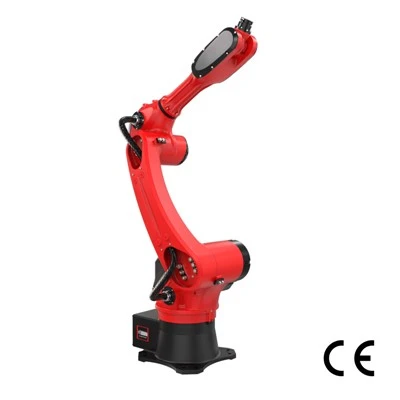
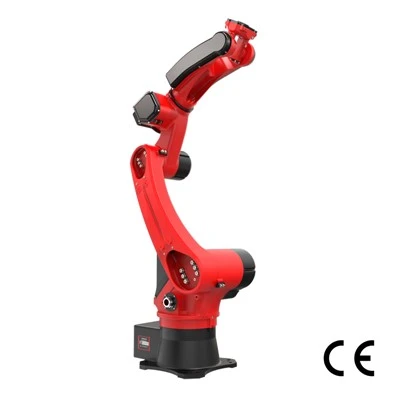
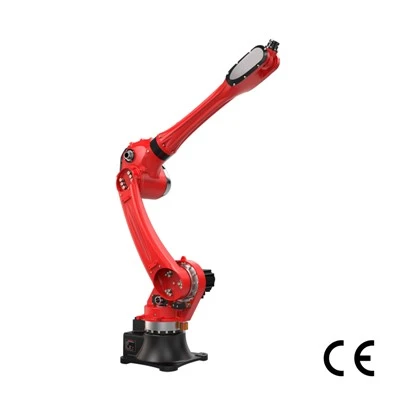
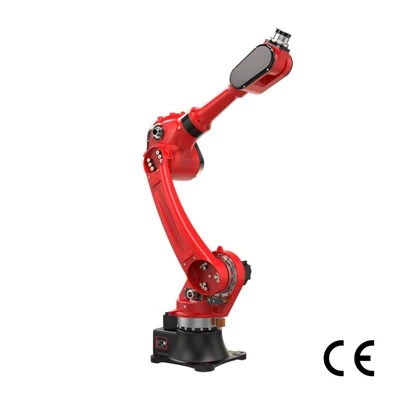
If you are planning pick-and-place automation, explore RBTIC pick-and-place robot series to review configurations and specifications.

Does a Pick and Place Robot Always Need Vision?
A pick and place robot only needs machine vision when it must identify or compensate for product variation that cannot be controlled mechanically or through other sensing methods.
Two different applications.
|
Scenario |
Part Position Condition |
Robot Operation Logic |
Vision System Requirement |
|
Scenario 1 |
A component is always located in the same fixture within a repeatable tolerance. |
The pick and place robot can move to a taught coordinate every cycle. |
Can operate reliably without a camera |
|
Scenario 2 |
Parts arrive randomly across a conveyor at different positions and orientations. |
The robot must determine where each part is before it can pick it. |
Normally requires some form of vision or position-detection system |
The purpose of robot vision is therefore not to make the automation system more sophisticated. Its purpose is to remove uncertainty that would otherwise prevent a reliable pick.
Key Factors That Determine How Much Pick and Place Robot Vision You Need
Before comparing no vision, 2D vision, and 3D vision, evaluate the application itself.
Several variables are especially important.
|
Core Factor |
Description |
|
Product Position Variation |
Ask how much the product moves from cycle to cycle. A part held in a precision fixture may have almost no positional variation. A loose product travelling on a conveyor may shift significantly in the X and Y directions. A randomly piled component can vary in X, Y, Z, pitch, roll, and yaw. The number of uncontrolled variables is one of the strongest indicators of the sensing capability required. |
|
Height and Depth Variation |
If every product is presented at approximately the same height, depth measurement may not be necessary. Once products can appear at significantly different heights, however, a 2D image may no longer provide enough information to determine a reliable picking pose. This is particularly important for stacked products, random bins, uneven surfaces, and components that may tilt. |
|
Product Orientation |
A robot may need more than the center position of a product. Depending on the application, it may also need to determine: in-plane rotation; full three-dimensional orientation; which side of the product is facing upward; whether a required gripping feature is accessible. The more orientation freedom a product has, the more demanding the sensing problem becomes. |
|
Overlap and Occlusion |
Products that remain separated and fully visible are easier to locate. Stacked, overlapping, or partially buried products create a different challenge. The system may need to distinguish individual objects, determine which one is accessible, and avoid collisions with surrounding products. This is one reason random bin picking typically requires more sophisticated sensing and planning than flat conveyor picking. |
|
Accuracy Requirements |
Vision should also be selected according to the tolerance of the process. A packaging application placing products into a large carton may tolerate more positional error than an assembly operation inserting a small component into a tightly controlled feature. Camera resolution, calibration quality, mounting stability, working distance, lens selection, and robot repeatability can all influence final system accuracy. |
|
Cycle Time |
A technically capable vision system is not automatically the right production solution. Image acquisition, object detection, pose calculation, robot communication, path planning, and gripping all consume time. For high-speed applications, the complete sensing and robot cycle should be evaluated rather than considering camera performance alone. |
When to Use a Pick and Place Robot Without Vision
A no-vision pick and place system can be the most appropriate solution when the product is already presented in a known and repeatable position.
Typical applications include:
parts located in fixed fixtures;
components presented in accurately positioned trays;
products stopped at a controlled indexed position;
repetitive transfer between fixed machines;
applications where mechanical guides determine the product position.
In these situations, the mechanical system has already removed most of the uncertainty. The robot can often move to predefined or taught pick coordinates without calculating a new pose for every cycle.
This approach has several potential advantages. It can reduce hardware requirements, simplify programming and calibration, shorten commissioning time, and eliminate unnecessary image-processing steps. More technology does not automatically produce a better automation cell. If mechanical positioning is already highly repeatable, adding a vision system can introduce complexity without solving a meaningful production problem.
No Vision Does Not Mean No Sensing
A robot cell without machine vision may still require sensors.
Common examples include photoelectric presence sensors, proximity switches, fixture confirmation sensors, vacuum pressure switches, part-present sensors, safety sensors.
These devices answer questions such as whether a product is available or whether a fixture is correctly positioned. The key distinction is that they do not normally calculate a new pick pose from an image.
A useful decision question is: Does the robot need to calculate a different product position or orientation for each cycle? If the answer is no, a fixed-coordinate approach may be sufficient.
When No Vision Becomes Risky
A no-vision system becomes less suitable when product presentation begins to drift.
Potential problems include inconsistent fixture loading, accumulated conveyor positioning error, variable packaging, changing product orientation, unstable mechanical stops, frequent format changes.
If these variations exceed the allowable picking tolerance, the process may need improved mechanical control, additional sensing, or machine vision.
When 2D Vision Is the Right Choice for Pick and Place
2D vision is commonly used when products move primarily across a known plane while their height remains relatively stable.
Typical examples include:
individual products on a flat conveyor;
components with varying X-Y positions;
products rotating on a flat surface;
parts distributed across a single-layer tray;
applications requiring visual identification or feature detection.
A 2D camera can typically help determine information such as X position, Y position, in-plane rotation, visible shape or feature information, product identity when distinguishable visual features are available.
For example, products travelling on a conveyor may arrive with irregular spacing and different orientations. Instead of relying on one fixed pick coordinate, a 2D vision system can locate each product and provide an updated position to the robot. If the conveyor is moving continuously, the robot control system may also need conveyor tracking and encoder synchronization so that the calculated pick position remains valid while the product moves.
Why 2D Vision Is Often a Practical Middle Ground
For essentially planar applications, 2D vision can provide the flexibility needed without introducing unnecessary depth measurement.
Compared with more complex 3D applications, the sensing problem usually contains fewer variables.
That can simplify camera setup, image processing, calibration, robot integration, troubleshooting.
However, these advantages depend on the application remaining sufficiently planar.
Limitations of 2D Vision
A conventional 2D image does not directly provide full depth information.
Problems can arise when:
products appear at significantly different heights;
objects are stacked;
the gripping surface may be tilted;
height affects the required pick position;
overlapping products must be separated spatially;
the robot needs a full 3D pose.
Lighting is another important factor. Poor contrast, shadows, glare, or inconsistent illumination can make otherwise simple 2D detection unreliable. Reflective and transparent products may require careful lighting and optical design.
The decision should therefore be based on the geometry and variability of the real production environment rather than on the assumption that 2D vision is always the simpler answer.
When 3D Vision Is the Better Choice for Pick and Place
3D vision becomes useful when depth, height, or three-dimensional orientation is part of the picking problem.
Common applications include:
random bin picking;
stacked components;
products at different heights;
irregular surfaces;
overlapping objects;
randomly tilted components;
applications requiring a three-dimensional object pose.
Instead of locating an object only within an image plane, 3D sensing can provide information about depth and surface geometry. Depending on the sensing technology and application, this information can help the system estimate an object's three-dimensional pose and identify potential picking surfaces.
Random Bin Picking: Why Depth Matters
A random bin demonstrates the difference between planar and three-dimensional sensing particularly well.
Imagine several metal components piled together. Knowing that one component appears near the center of a 2D image may not be enough.
The robot may also need to determine whether the component is on top of the pile, how high it is, whether it is tilted, whether another component is covering it, whether the intended gripping surface is accessible, whether the robot can approach without colliding with surrounding parts. These questions require more than basic X-Y position information.
3D Vision Does Not Solve Every Picking Problem
One of the most important design principles in robotic picking is that successful object detection is not the same as successful object picking. A 3D vision system may correctly identify a component while the pick and place robot still cannot grip or extract it.
Possible causes include severe occlusion, poor gripping geometry, unstable product piles, inaccessible gripping surfaces, collision risks, reflective or transparent materials, insufficient clearance between products.
For this reason, 3D vision should be evaluated together with the gripper, robot reach, collision strategy, product geometry, and path-planning method. It should not be treated as an independent solution to every difficult picking problem.
No Vision vs 2D Vision vs 3D Vision: Comparison
The following table summarizes the main differences.
|
Factor |
No Vision |
2D Vision |
3D Vision |
|
Typical product position |
Fixed and repeatable |
Variable mainly in X-Y |
Variable in X-Y-Z |
|
Height variation |
Minimal |
Low or predictable |
Moderate to high |
|
Orientation |
Fixed or mechanically controlled |
Mainly in-plane rotation |
Full 3D orientation may be possible |
|
Overlapping products |
Usually unsuitable |
Limited capability depending on visibility |
Better suited to stacked or overlapping scenes |
|
Typical applications |
Fixtures, indexed stations, fixed transfers |
Conveyor picking, planar sorting, tray picking |
Bin picking, stacked parts, variable-height picking |
|
System complexity |
Lowest |
Moderate |
Generally highest |
|
Calibration requirements |
Minimal |
Vision-to-robot calibration required |
More demanding 3D calibration and validation |
|
Lighting sensitivity |
Low from a vision perspective |
Often important |
Depends strongly on sensing technology and surface properties |
|
Relative integration effort |
Low |
Medium |
Higher |
|
Best suited for |
Deterministic product presentation |
Flexible planar picking |
Three-dimensional uncertainty |
This table should be treated as a starting point rather than a rigid rule.
Real applications can combine technologies. For example, a system may use mechanical guides to reduce product variation, 2D vision for localization, and additional sensors for process confirmation. The goal is not to select the most advanced sensing system. It is to use the simplest sensing architecture that can consistently resolve the uncertainty that matters to the process.
Other Factors That Affect Robot Vision Performance for Pick and Place
Choosing between no vision, 2D vision, and 3D vision is only part of the automation design. Several other factors can have an equally large impact on reliability.
|
Other Influencing Factors |
Description |
|
Lighting Conditions |
Machine vision depends on usable image data.Changes in ambient light, shadows, glare, reflections, and inconsistent illumination can reduce detection performance.Lighting should therefore be treated as part of the vision system rather than as an afterthought. |
|
Reflective and Transparent Products |
Highly reflective, glossy, dark, or transparent surfaces can be challenging for both 2D and 3D sensing.The severity depends on the sensing technology, camera arrangement, illumination, product geometry, and required accuracy.Testing representative production samples is often more useful than selecting technology purely from specifications. |
|
Camera and Robot Calibration |
The robot must understand how the coordinates measured by the vision system relate to its own coordinate system.Calibration errors can turn accurate visual detection into inaccurate robot motion.Mounting stability, calibration procedures, tool-center-point accuracy, and robot repeatability should therefore be considered together. |
|
Gripper Design |
Vision determines where the product is.The gripper determines whether the product can actually be picked.Vacuum cups, mechanical fingers, magnetic grippers, and custom end-of-arm tooling all impose different requirements on product orientation, surface condition, contact area, and approach direction.This is why vision selection and end-of-arm tooling should be developed as part of the same application strategy. |
|
Product Presentation |
Improving product presentation can sometimes reduce the need for more complex vision.Fixtures, guides, escapements, feeders, singulation mechanisms, and controlled conveyors can remove uncertainty before the robot sees the product.In some applications, investing in better product presentation can produce a more reliable system than trying to solve every variation through additional image processing. |
|
Required Production Reliability |
A system that works during a short demonstration is not automatically production-ready.Testing should include realistic variations such as acceptable product tolerances, different batches, surface changes, lighting changes, partially damaged packaging, position extremes, realistic conveyor speeds, normal contamination or dust conditions where applicable. |
The relevant question is not whether the system can make one successful pick.It is whether it can maintain the required performance over the expected range of production conditions.
Pick and Place Vision Selection Checklist
Before selecting a vision architecture, answer the following questions.
|
Category |
Check Questions |
|
Product presentation |
Is the product position fixed or variable? Is the orientation controlled? Can products overlap? Can products be stacked? Does product height change? |
|
Picking requirements |
What positional accuracy is required? Does the robot need only X-Y position or a full 3D pose? Does the gripping point remain accessible? Can the gripper tolerate some position variation? |
|
Production conditions |
Is the product stationary or moving? What cycle time is required? Are lighting conditions stable? Are the products reflective, transparent, dark, or visually inconsistent? Will multiple product formats use the same cell? |
|
System design |
Can mechanical guides or fixtures remove some uncertainty? Is camera-to-robot calibration practical? Does the robot need conveyor tracking? Can the vision system communicate fast enough for the required cycle? Has the application been tested with representative production samples? |
A practical selection sequence is:
Use no vision when product presentation already provides repeatable positioning.
Use 2D vision when the main uncertainty occurs across a predictable plane.
Use 3D vision when meaningful height, depth, tilt, stacking, or three-dimensional orientation must be resolved.
Then validate that choice against gripping, accuracy, cycle time, environment, and production reliability.
Frequently Asked Questions for Pick and Place Robot Vision
Final Takeaway
The choice between no vision, 2D vision, and 3D vision should begin with the uncertainty in the picking task, not with the sophistication of the camera.
If the product is mechanically constrained to a stable position, predefined robot coordinates may be enough. If position varies mainly across a flat plane, 2D vision can provide the flexibility needed to locate and orient the product. If the robot must understand meaningful depth, height, tilt, stacking, or three-dimensional orientation, 3D vision becomes a stronger candidate.
But vision is only one part of a reliable pick and place system. Product presentation, gripper design, calibration, lighting, cycle time, accuracy, and real production variability all affect the final result. The most effective solution is therefore not necessarily the one with the most advanced vision technology. It is the one that removes enough uncertainty to make every required robot pick repeatable, practical, and reliable.
Ready to implement robotic pick and place?
Whether you are upgrading your end‑of‑line automation or searching for a reliable pick-and-place robot supplier, contact RBTIC for free custom pick-and-place solutions and layout designs, or to book a factory tour.