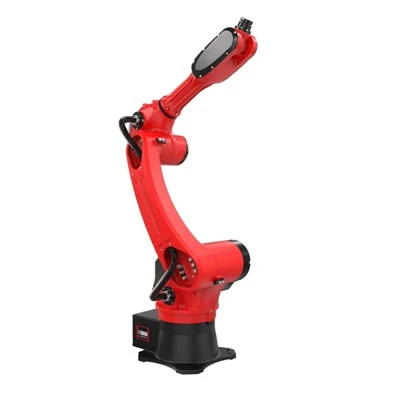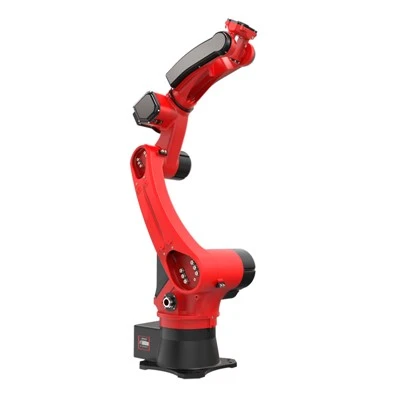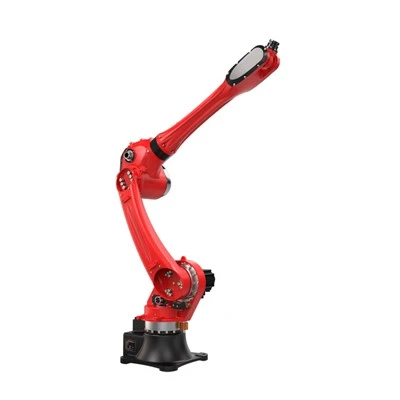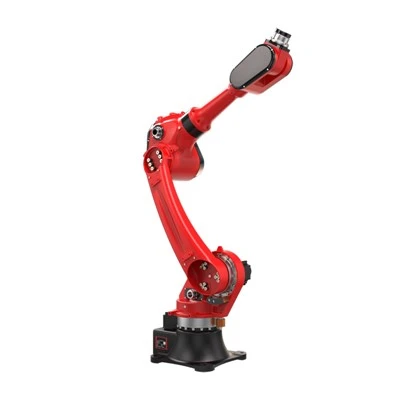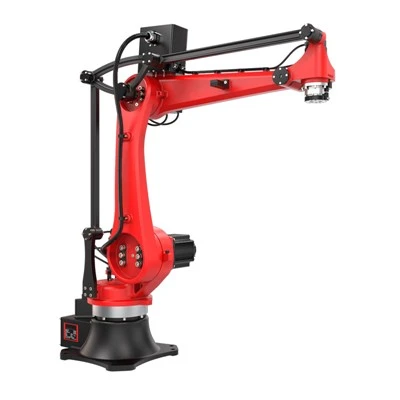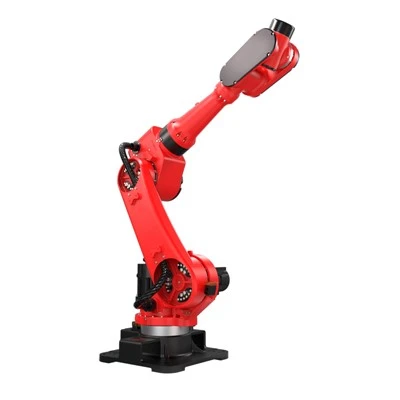

Welding robots mainly consist of two parts: the robot itself and the welding equipment. The robot comprises the robot body and a control cabinet (hardware and software). Welding equipment, taking arc welding and spot welding as examples, consists of a welding power source (including its control system), a wire feeder (for arc welding), and a welding torch (or clamp). Intelligent robots should also have a sensing system, such as laser or camera sensors and their control devices. In recent years, humanoid welding robots have been developed as a new system design. Their core is the construction of a "cerebellum" motion control system, combined with a bionic body and three subsystems: execution, perception and decision-making, and welding expertise. The aim is to improve welding accuracy and efficiency and adapt to complex industrial scenarios.
Welding robots produced worldwide are mostly articulated robots, with the vast majority having six axes. Axes 1, 2, and 3 can move the end effector to different spatial positions, while axes 4, 5, and 6 address different tool posture requirements. The mechanical structure of the welding robot body mainly takes two forms: a parallelogram structure and a side-mounted (swinging) structure. The main advantage of a side-mounted (swinging) structure is the large range of motion of the upper and lower arms, allowing the robot's workspace to almost reach the size of a sphere. Therefore, this type of robot can work upside down on a frame, saving floor space and facilitating the movement of objects on the ground. However, this type of side-mounted robot has a cantilever structure for its 2nd and 3rd axes, reducing the robot's rigidity. It is generally suitable for robots with smaller loads, used for arc welding, cutting, or spraying. A parallelogram robot's upper arm is driven by a lever. The lever and lower arm form two sides of a parallelogram, hence the name. Early parallelogram robots had relatively small workspaces (limited to the front of the robot), making upside-down operation difficult. However, new parallelogram robots (parallel robots) developed since the late 1980s have expanded the workspace to the top, back, and bottom of the robot, without the rigidity problems of side-mounted robots, thus gaining widespread attention. This structure is suitable for both light and heavy robots. In recent years, most spot welding robots (load capacity 100-150kg) have adopted a parallelogram structure.
Both types of robots described above involve rotary motion on all axes, thus employing servo motors driven by cycloidal pinwheel (RV) reducers (axes 1-3) and harmonic reducers (axes 1-6). Prior to the mid-1980s, electrically driven robots used DC servo motors, but since the late 1980s, various countries have switched to AC servo motors. Because AC motors are brushless and have superior dynamic characteristics, new robots not only have lower accident rates but also significantly increased maintenance-free time and faster acceleration/deceleration. Some new lightweight robots with load capacities under 16kg can achieve a maximum tool center point (TCP) speed exceeding 3m/s, with accurate positioning and minimal vibration. Simultaneously, the robot control cabinet has been upgraded to a 32-bit microcomputer and new algorithms, enabling it to automatically optimize its path, resulting in a trajectory that more closely resembles the taught path.