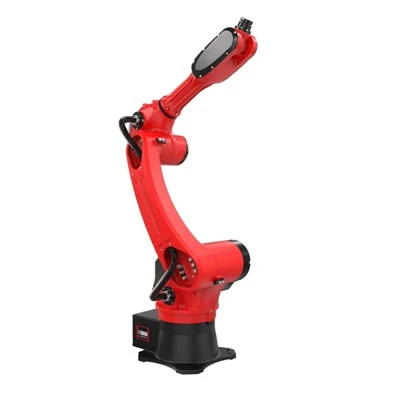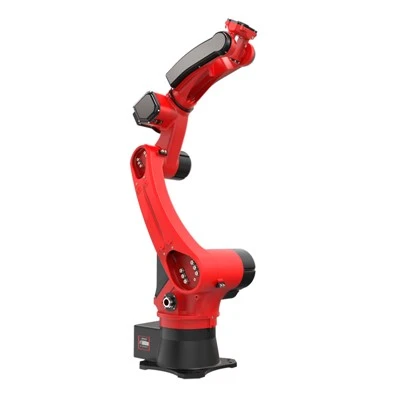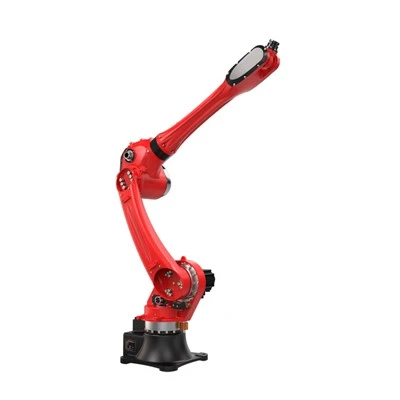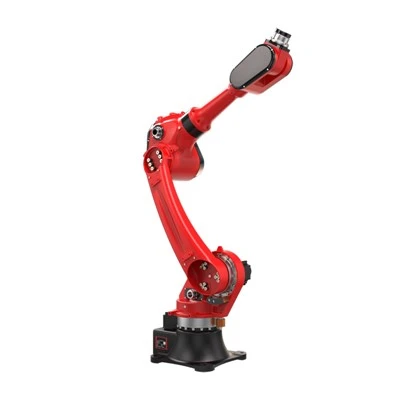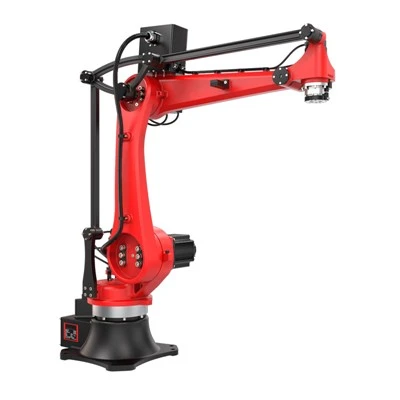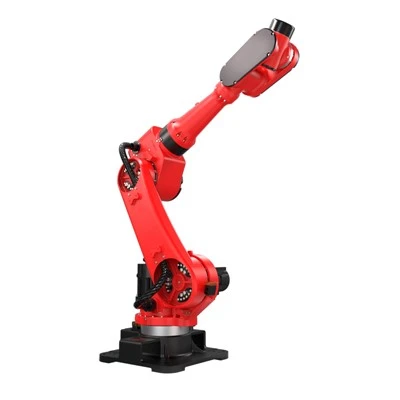

Industrial robots typically consist of three main parts and six subsystems. The three main parts are the mechanical part, the sensing part, and the control part. The six subsystems can be divided into the mechanical structure system, the drive system, the perception system, the robot-environment interaction system, the human-machine interaction system, and the control system.
Mechanical Structure System:
From a mechanical structure perspective, industrial robots are generally divided into serial robots and parallel robots. A characteristic of serial robots is that the movement of one axis changes the coordinate origin of another axis, while the movement of one axis in a parallel robot does not change the coordinate origin of another axis. Early industrial robots all used serial mechanisms. A parallel mechanism is defined as a closed-loop mechanism in which the moving platform and the fixed platform are connected by at least two independent kinematic chains, the mechanism has two or more degrees of freedom, and is driven in parallel.
A parallel mechanism has two components
The wrist and the arm. The arm's range of motion has a significant impact on the workspace, while the wrist is the connection between the tool and the main body. Compared with serial robots, parallel robots have advantages such as higher stiffness, structural stability, higher load-bearing capacity, higher micro-motion precision, and lower motion load. In solving position problems, the forward inversion method is easy for serial robots, but extremely difficult for parallel robots; conversely, the forward inversion method is difficult, but the inversion method is very easy.
Drive System
The drive system provides power to the robot's joints and typically consists of motors, reduction gears, and transmission components. Its performance significantly impacts the robot's speed response, motion smoothness, and positioning accuracy. The control system is the core component of an industrial robot, primarily used to execute program instructions, coordinate joint movements, and manage input/output signals, achieving unified control over the robot's trajectory, posture, and workflow.
Sensing System
The sensing system acquires information about the robot's state and operating environment, including position, velocity, force, and external environmental characteristics, providing feedback to the control system. Through the introduction of sensor information, industrial robots can maintain stable operation under complex conditions and, to some extent, adjust and optimize the work process. The end effector is the component of the industrial robot that directly contacts the workpiece or tool. Its form varies depending on the task, such as a gripper, welding torch, spray gun, or specialized tooling, and it serves as a crucial interface for specific industrial operations.
End Effector: Robot-Environment Interaction System
A robot-environment interaction system is a system that enables robots to communicate and coordinate with equipment in their external environment. The robot and external equipment are integrated into a functional unit, such as a processing and manufacturing unit, welding unit, or assembly unit. Alternatively, multiple robots can be integrated into a single functional unit to perform complex tasks.
Human-Machine Interaction System
A human-machine interaction system is a device that allows humans to communicate with and participate in the control of a robot. Examples include standard computer terminals, command consoles, information display panels, and hazard alarms.
Control System
The task of a control system is to direct the robot's actuators to complete specified movements and functions based on the robot's work instructions and signals fed back from sensors. If the robot lacks feedback characteristics, it is an open-loop control system; if it has feedback characteristics, it is a closed-loop control system. Based on control principles, control systems can be divided into program control systems, adaptive control systems, and artificial intelligence control systems. Based on the form of motion control, control systems can be divided into point-to-point control and continuous trajectory control.