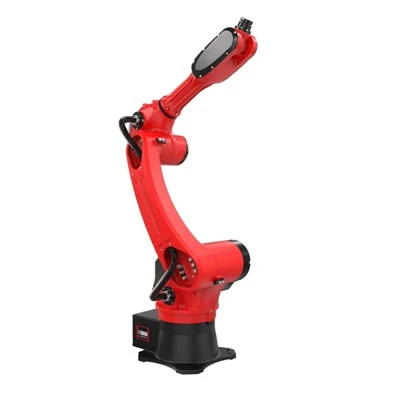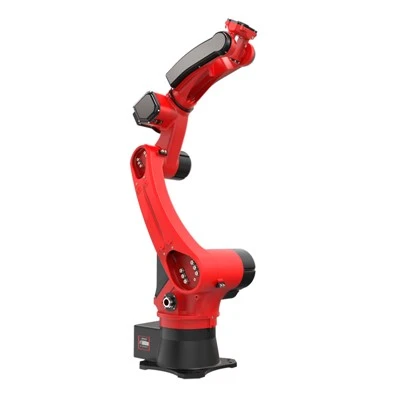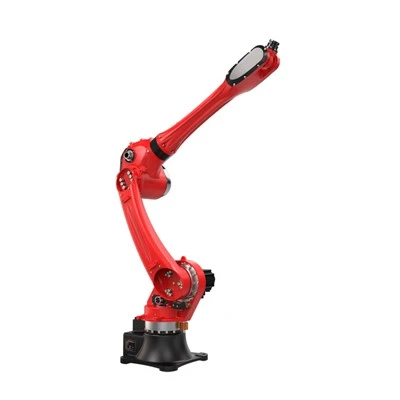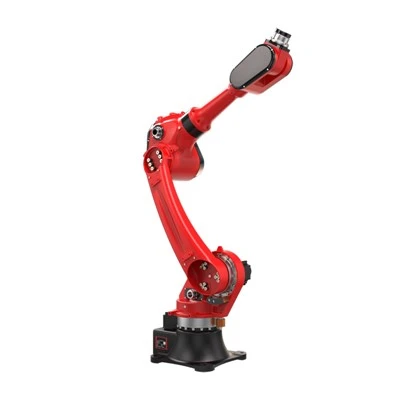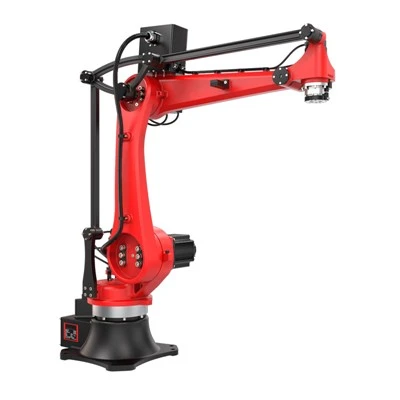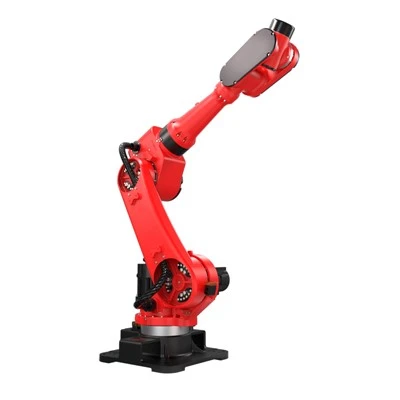

Spot welding doesn't place high demands on welding robots. This is because spot welding only requires point-to-point control; the movement trajectory of the welding gun between points is not strictly controlled, which is why robots were initially only used for spot welding. Spot welding robots not only need sufficient load capacity but also need to move quickly, smoothly, and accurately between points to reduce movement time and improve work efficiency. The required load capacity of a spot welding robot depends on the type of welding gun used. For welding guns separated from the transformer, a robot with a load capacity of 30-45 kg is sufficient. However, this type of welding gun suffers from high energy loss due to long secondary cables and is not conducive to the robot extending the welding gun into the workpiece for welding; furthermore, the cable swings constantly with the robot's movement, leading to faster cable damage. Therefore, integrated welding guns are increasingly being used. These welding guns, including the transformer, weigh around 70 kg. Considering the robot's need for sufficient load capacity to deliver the welding gun to the desired position with high acceleration, heavy-duty robots with a load capacity of 100-150 kg are generally selected. This is to meet the requirements of short-distance, rapid movement of the welding gun during continuous spot welding. The new heavy-duty robot adds the ability to complete a 50mm displacement within 0.3 seconds. This places higher demands on motor performance, microcomputer processing speed, and algorithms.
Flexible manufacturing intelligent welding robots possess visual recognition capabilities and are characterized by high flexibility and environmental adaptability, making them suitable for various types of customized welding work in complex environments. The development of humanoid welding robots aims to address pain points in the industrial sector such as welder shortages, low precision and efficiency of traditional welding, replacing high-risk manual welding, and adapting to complex industrial scenarios.